

SCAM WARNINGS !
SCAMS WARNINGS Host Jay White is a volunteer attorney who
serves low income seniors in San Mateo County California.
( To send a message click on ”Leave a Comment” above. )
February 3, 2019
TAX IDENTITY THEFT
It’s Tax Identity Theft Awareness Week. It is time to get up to date on protecting yourself from identity thieves. They are imposters who pretend they’re from the IRS, but they are thieves out to get your money.
Tax identity theft happens when someone uses your Social Security number (SSN) to get your tax refund, or possibly a job using your name. Scammers may offer to expedite your tax return—if you send them your Social Security number and a “commission” in advance.
You might not find out it’s happened until you receive a letter from the IRS saying that more than one tax return was filed with your SSN, or IRS records show you earned income from an employer you don’t know, or the IRS received a duplicate of your e-filed tax return.
One of the most common ways an identity thief can capture your SSN and personal information is through phishing. Phishing is a scam message intended to trick you into revealing your SSN and/or personal information. These phishing scams typically come in the form of a fraudulent email, or even a phone call, where the identity thieves will disguise themselves as an IRS official requesting your personal information. The IRS will never contact you via email, so make sure to immediately delete any messages that appear to be from the IRS. If you receive a suspicious phone call from the IRS, do not give out your personal information. It is in your best interest to confirm a purported IRS employee’s identity by calling the official IRS hotline at 1-800-829-1040.
Meanwhile, here are suggestions to help fight tax identity theft:
File your return as early in the tax season as you can.
Use a secure internet connection if you file electronically, or mail your tax return from the post office.
Visit Internet Tax-Related Identity Theft to learn more.
File your tax returns yourself, or through a trusted accountant or tax return agency.
File your tax returns on time, do not delay!
Regularly check your credit report for irregular activity.
Enable fraud alerts with your credit and banking institutions.
Your SSN card should be in a secure place. Not in your wallet, purse, or hand-bag.
Do not leave your wallet/purse vulnerable in unlocked cars, or desks at work.
Do not give out personal information or your SSN to suspicious callers or strangers.
Never click or links or open attachments in suspicious emails.
Use different passwords for banking and credit institutions than you do for social networks, online stores, etc.
In addition, use unique and secure passwords. Include numbers, possibly using upper and lower case letters, and special characters. Change them regularly!
Keep your computers and electronic devices updated with current patches and security updates.
If you file your return later in the tax season you may find out that an identity thief has already filed a return using your SSN. If you find out that you have become a victim of tax related identity theft, it is important to contact the IRS immediately. The phone number for the “IRS Identity Protection Specialized Unit” is 1-800-908-4490.
—————————-
January 26, 2019
IRS WARNING
The Internal Revenue Service warned the public of a new malware scam identified as Emotet. A surge of fraudulent emails impersonating the IRS is using tax transcripts as bait. It entices users to open documents containing malware.
The United States Computer Emergency Readiness Team (US-CERT) issued a warning in July about earlier versions of the Emotet in Alert (TA18-201A). It labeled Emotet Malware “among the most costly and destructive malware affecting state, local, tribal, and territorial (SLTT) governments, and the private and public sectors.”
The scam has masqueraded as the IRS, pretending to be from “IRS Online.” The scam email carries an attachment labeled “Tax Account Transcript” or something similar, and the subject line uses some variation of the phrase “tax transcript.”
The IRS reminds taxpayers it does not send unsolicited emails to the public, nor would it email a sensitive document such as a tax transcript — which is a summary of a tax return. The IRS urges taxpayers not to open the email or the attachment. If using a personal computer, delete it or forward it to phishing@irs.gov.
January 22, 2019
FAKE FUNERAL NOTICE
There is no limit to how low scammers will go to steal your money—even to sending you a fake funeral notice. Scammers are sending bogus emails with the subject line “funeral notification.” The message appears to be from a legitimate funeral home, offers condolences, and invites you to click on a link for more information about the upcoming “celebration of your friend’s life service.” Don’t do it. Instead of sending you to the funeral home’s website, the link sends you to a domain where the scammers download malware to your computer.
Criminals use malware to steal personal information, send spam, and commit fraud. Malware, short for “malicious software,” includes viruses and spyware that get installed on your computer without your consent. These programs can cause your computer to crash and can be used to monitor and control your online activity.
If you receive an email about a friend or loved one’s passing, the Federal Trade Commission, the nation’s consumer protection agency, says hit Delete. Don’t click on the link. If you wish, you can then contact the funeral home or family directly for accurate information.
To reduce your risk of downloading unwanted malware and spyware:
Keep your security software updated.
Don’t click on any links or open any attachments in emails unless you know who sent it and what it is.
Make sure your browser security setting is high enough to detect unauthorized downloads.
Download and install software only from websites you know and trust. Resist buying software in response to unexpected pop-up messages or emails, especially ads that claim to have scanned your computer and detected malware.
Back up your data regularly.
For general tips about avoiding and getting rid of malware, visit Google’s Computer Security.
Attb: FTC
——————————————————————-
January 18, 2019
GOVERNMENT SHUTDOWN SCAMS
With thousands of Government workers living without a paycheck, scammers are out in force. For a worker with bills to be paid and with no income and little savings, this is a crisis. Understandably, when receiving a call from someone with a friendly voice purporting to offer help, it cannot easily be ignored.
The contact could be by telephone, e-mail, robocall, TV or some other means. But the scammer’s purpose is to steal your hard-earned money.
As part of the scam, the caller may pretend to represent a charity that will offer you a low-cost loan. The scammer may offer to expedite a loan by transferring money directly to your bank account. That means you would need to provide the scammer your bank account number. Don’t do it.
Do not give out your bank account number, Social Security number, birth date or any other personal information. A scammer who has access to your bank account could take whatever money is currently there — and future deposits.
As an alternative, a loan from a reputable organization such as a bank or credit union could be very helpful in bridging the gap until your next paycheck. But responding and giving personal information to an unidentified or unknown person would be very risky.
Any such attempt to steal your money should be reported to the Federal Trade Commission at http://www.FTC.gov. That could help others avoid being scammed.
——————————————————————————-
January 14, 2019
YAHOO TELEPHONE SCAM
If you need to contact Yahoo customer care there are a few ways to do so — but, Yahoo warns that phone is not an option. Any phone number you come across claiming to connect you with Yahoo customer care, is fake.
The Federal Trade Commission has received reports that consumers who called these fake customer care numbers were offered “Yahoo customer care services” for a fee.
But Yahoo customer support is always free of charge. That means you should never pay to have your Yahoo password reset, for technical support, or help with security concerns. Also, Yahoo won’t ask to remotely connect to your computer for any support-related request.
Attb. FTC
——————————————————-
January 14, 2019
SWEEPSTAKES SCAMS
Congratulations! You’ve won the Sweepstakes! You’ve won a car, valuable jewelry, cash, or some other fabulous prize.
Is this really your lucky day? Or is your luck about to take a turn for the worse?
Be cautious before you claim your big prize or sweepstakes win.
Be on guard for imposters. Some con artists use company names that are identical or very similar to well-known, legitimate sweepstakes operators. The first contact by a scammer may be by mail, pop-up or E-mail.
Never pay to play.
Don’t believe that you have to give the scammer money in advance for taxes, administrative expensive or other phony reason.
Guard your credit card, bank account and Social Security numbers. No legitimate sweepstakes company will ask for this information.
How it works.
A scammer offers to send you an “advance” on your “winnings.” Some con artists use this ploy to build trust and get money from your bank. They send you a check for part of your “winnings,” instructing you to deposit it and then wire money to them for taxes, bonding, or some other phony purpose.
After depositing the check, you write a check on your account and mail it to the scammer. After you mail the money, the check that you deposited bounces because it turned out to be an elaborate fake. Now the crooks have your money, and you’re left owing your bank the amount that you withdrew.
Legitimate sweepstakes companies will give you written information about how a contest works, including the odds of winning, the value of the prizes, the fact that no purchase is necessary, and an explanation that buying something does not improve your chances of winning.
Don’t be fooled by official-looking advertisements. It’s not necessarily legitimate just because the envelope is marked “urgent” and the contents look impressive. One clue that you haven’t really won is if the letter was sent at bulk mail rates.
Be especially cautious about foreign sweepstakes companies. Many fraudulent sweepstakes companies that target U.S. consumers are located in Canada or other countries. That makes it much more difficult for law enforcement agencies to pursue them, or for the Federal Trade Commission to recover any money.
If you experience such a scam you can report it to the Federal Trade Commission: www.ftc.gov.
Attb: fraud.org
———————————————————————————
January 10, 2019
90# TELEPHONE SCAM
Don’t Fall for the 90# Telephone Scam
A legacy phone scam using the 90# buttons on business landline telephones is still around. It targets phones served by a private branch exchange (PBX) or private automatic branch exchange (PABX). These calls are used to trick subscribers into taking actions that will enable the scammer to place fraudulent calls at the subscriber‘s expense.
How this scam works
You may receive a call at your office from someone claiming to be a telephone company employee investigating technical problems with your line, or checking up on calls supposedly placed to other states or countries from your line. The caller asks you to aid the investigation by either dialing 90# or by transferring the call to an outside line before hanging up. By doing this, you may be enabling the caller to place calls that are billed to your telephone number.
What you should know
Telephone company employees checking for technical and other types of telephone service or billing problems would not call and ask a subscriber to dial a specific series of numbers. Telephone company employees would not request subscribers to connect the caller to an outside line.
What you can do
Your telecommunications manager should contact the telephone companies that provide you with local and long-distance service. Ask for information about security systems available to protect your telephone system from toll fraud. You could also consider asking about any monitoring services that help detect unusual telephone system usage.
To avoid becoming a victim of this scam, familiarize yourself and your employees about the scammer’s tactics.
Take the following steps if you think that a telephone call is fraudulent or is part of this scam:
*Ask the caller for their name and telephone number.
*Tell the caller you are going to call the telephone company immediately to determine whether or not there is a problem with the line.
*Hang up the receiver; do not dial any unknown numbers or transfer the caller to an outside line before hanging up.
*Call the telephone number for your telephone service provider and/or its security office and report the suspicious phone call. Be prepared to provide details of the call to the telephone company representative.
Report your experience to your local law enforcement officials and the Federal Communications Commission: www.ftc.gov.
Attb: FTC
———————————————————————————
January 7, 2018
SMALL BUSINESS TECH SCAM
Here is how it works.
As a business owner, your employee may receive a phone call, pop-up, or email warning about a problem with the office computer. In an effort to be helpful, the employee follows instructions to send money, turn over personal information, or provide access to your computer system. As a small business owner, you likely know it’s a tech support scam, but not every member of your team has the savvy to spot it.
Scammers often pretend to be from a well-known computer-related company. They use confusing tech talk and smoke-and-mirrors chicanery to convince your employee that emergency action is necessary.
The next step varies depending on what the scammer is after. Data thieves may propose a “fix” that requires remote access to your computer network. Once given access, they steal sensitive data or install malware to facilitate future invasions—or damage your computer’s operating system.
Other scammers just care about the cash. They may try to convince your employee to enroll in a worthless computer “maintenance” or “warranty” program. Or they’ll ask for a credit card number so they can bill your business for bogus repairs. In a variation on the scam, they may direct your employee to a website where they ask for account information, passwords, or personal data.
The Federal Trade Commission can help protect your company from cybersecurity risks, including tech support scams.
How To Protect Your Business.
If someone calls your employee and says there’s a problem with the computer – even if it looks like a local number or the caller ID says it’s from a well-known company – instruct your employee to hang up.
If it’s an email that appears to come from a trusted business, don’t respond. Don’t click on any links. Don’t share passwords. And don’t call a phone number included in the message.
If the message arrives as a pop-up, the advice is the same: Don’t respond. Don’t click. Don’t share. Don’t call. Tech support scammers are experts at falsifying caller IDs, email addresses, URLs, etc.
Some pop-up messages about computer issues are legitimate. Sometimes your Information Technology people need to talk to an employee. You can train your employees to respond by calling or emailing a co-worker you designate, using a number or address you have provided in advance.
What to do If you are Scammed
If someone at your business has shared a password with a scammer, change it on every account that uses that password. Use unique passwords for each account.
To protect against malware, use legitimate security software and keep it current. Use the software’s scan feature and delete anything it flags as a problem. If you need help, consult a trusted security professional. If a computer infected by malware is connected to your network, you or a security professional should check the entire network for intrusions. Report an attack right away at FTC.gov/complaint.
If an employee paid by credit card for bogus services from a tech support scammer, ask your credit card company to reverse the charges. Keep checking your monthly statements to make sure the scammer doesn’t try to go back for seconds – and report it to the FTC.
You can raise these cautionary points at your next staff meeting.
Attb: FTC
————————————————————————————–

January 5, 2019
SWEETHEART SWINDLE
Online dating can be fun and convenient, but falling for a sweetheart swindle can be costly. Be wary of “friends” you meet online who develop a relationship with you. It may be someone who would con you out of hundreds or even thousands of dollars.
Be cautious. Falling in love with a con artist has consistently been ranked as one of, if not, the most expensive scams for the victims. It’s not hard to see why. Love is a powerful emotion. Most normal persons would do practically anything to help a friend or loved one in need. Fraudsters know this, which is why they devote significant time and energy to developing friendships and “love” with their marks. However, these criminals aren’t looking for a soulmate. They’re looking for vulnerable victims that have money.
The scams typically begin the same way. The victim is first approached on an online dating website, a social media platform such as Facebook, or another type of online forum. As the relationship develops and false trust is built, the “friend” asks the victim to send money to help them out of some fake situation.
How can you spot a romance scam and avoid falling victim?
Here are red flags that the person you’re dealing with is after your cash, instead of your heart:
He or she requests that you wire money to them.
The “relationship” becomes romantic extremely quickly, with quick pronouncements of love or close friendship.
He or she claims to be a U.S. citizen who is abroad, very wealthy, or a person of important status.
He or she claims to be a contractor and needs your help with a business deal.
He or she makes excuses about not being able to speak by phone or meet in person.
He or she quickly asks you to communicate via email, instant messaging, or text messaging instead of the online dating sites’ messaging services.
He or she claims to be American, but makes frequent spelling or grammar mistakes that a native English speaker wouldn’t.
If you’ve been approached by someone you think could be a romance scammer or if you’ve already fallen victim, DON’T keep speaking with that person. Ignore their emails, phone calls, IMs, or other communications. Instead, file a complaint at www.ftc.gov or http://www.Fraud.org.
Attb: fraud.org
———————————————————————————–
January 2, 2019
GRANDPARENT SCAM
In a typical Grandparent Scam, a con artist calls or emails the victim posing as a grandson or granddaughter. The caller explains he or she is in trouble and needs money. It will be used for bail money, lawyer’s fees, hospital bills, or another fictitious expense.
The victim is urged not to tell anyone, such as the parent of the “grandchild”, because, allegedly, the grandchild does not want them to find out about the difficulty.
The caller is usually in a very noisy room so the grandparent cannot identify the voice as not being that of the grandchild.
The grandparent is urged to promptly forward money to a designated address that cannot be traced. Scam artists’ payment method of choice is the wire transfer
After promptly sending money, the grandparent never hears from their fake grandchild again, have been tricked out of hundreds or even thousands of dollars.
To detect and avoid the Grandparent Scam, NCL’s Fraud Center recommends the following tips:
Beware of any urgent solicitation of funds, especially if it is needed to pay for unexpected bills, such as bail money, lawyer’s fees, or doctor bills
Before sending funds, independently contact the relative (or parent of the relative) the scam artist is claiming to be (or represent) at a known phone number to verify the details of the story.
Be aware that fraudsters attempting the Grandparent Scam may call late at night to confuse potential victims.
Any urgent request to wire money for any reason should be treated suspiciously.
Consumers who have been victims of this scam should immediately report it to local law enforcement, their state attorney general and NCL’s Fraud Center at Fraud.org.
Attb: Fraud.org
——————————————————————————————-
December 31, 2018
SOCIAL SECURITY SCAM
It is still happening. People are pretending to be from the Social Security Administration (SSA) and trying to get your Social Security number or your money. That scam is now growing exponentially. To compare: in 2017, we heard from 3,200 people about SSA imposter scams, and those people reported losing nearly $210,000. So far in 2018, more than 35,000 people have reported the scam, and they say they’ve lost $10 million.
Here’s what one of those scam calls may sound like:
A scammer calls saying your Social Security number (SSN) has been suspended because of suspicious activity, or because it’s been involved in a crime. The scammer wants you to confirm your SSN to reactivate it. He may say your bank account is about to be seized – but he’ll tell you what to do to keep it safe. He may direct you to put your money on gift cards and give him the codes – which, of course, means that your money will be gone.
Your caller ID often shows the real SSA phone number (1-800-772-1213) when these scammers call – but they’re faking that number. It’s not the real SSA calling.
Here’s what to know:
Your Social Security number is not about to be suspended. You don’t have to verify your number to anyone who calls. And your bank accounts are not about to be seized.
SSA will never call to threaten your benefits or tell you to wire money, send cash, or put money on gift cards. Anyone who tells you to do those things is a scammer.
The real SSA number is 1-800-772-1213, but scammers are faking by putting that number in the caller ID. If you’re worried about what the caller says, hang up and call 1-800-772-1213 to speak to the real SSA. Even if the wait time is long, confirm with the real SSA before responding to one of these fake calls.
Never give any part of your Social Security number, bank account number or credit card number to anyone who contacts you.
If you receive one of these calls, tell the FTC at ftc.gov/complaint. That could help someone else avoid being scammed.
Attb: FTC
———————————————————————————–
December 27, 2018
Netflix phishing scam
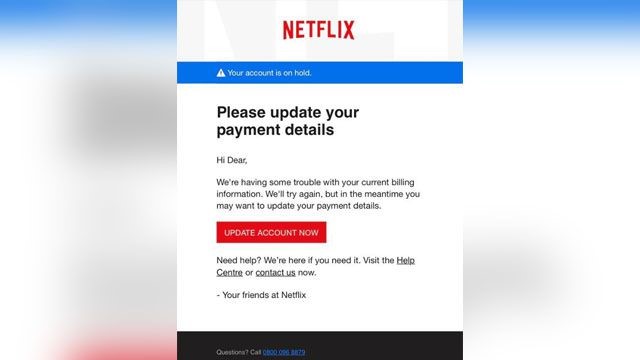
Scammers often use familiar company names or pretend to be someone you know. Here’s a real world example featuring Netflix. Police in Ohio shared a screenshot of a phishing email designed to steal personal information. The email claims the user’s account is on hold because Netflix is “having some trouble with your current billing information” and invites the user to click on a link to update their payment method.
Before you click on a link or share any of your sensitive information:
- Check it out. If you have concerns about the email, contact the company directly. But look up their phone number or website yourself. That way, you’ll know you’re getting the real company and not about to call a scammer or follow a link that will download malware.
- Take a closer look. While some phishing emails look completely legit, bad grammar and spelling can tip you off to phishing. Other clues: Your name is missing, or you don’t even have an account with the company. In the Netflix example, the scammer used the British spelling of “Center” (Centre) and used the greeting, “Hi Dear.” Listing only an international phone number for a U.S.-based company is also suspicious.
- Report phishing emails. Forward them to spam@uce.gov (an address used by the FTC) and to reportphishing@apwg.org (an address used by the Anti-Phishing Working Group, which includes ISPs, security vendors, financial institutions, and law enforcement agencies). You can also report phishing to the FTC at ftc.gov/complaint. Also, let the company or person that was impersonated know about the phishing scheme. For Netflix, forward the message to phishing@netflix.com.
Attb: FTC
———————————————————————————–
December 24, 2018
PayPal SCAM
Scammers posing as buyers of items for sale online have mastered the art of spoofing PayPal emails to instruct sellers to send their items and get away with them for free.
In a typical scam, a consumer who has placed an item for sale on a website like Craigslist receives a reasonable offer from a scammer posing as a buyer. The scammer and the seller agree on the price, and the scammer claims to send their payment through PayPal.
However, unbeknownst to the seller, the scammer never sends their payment to PayPal. Instead, the scammer sends a spoofed PayPal email saying that the payment has been received, but that it will only be released to the seller once that item has been mailed by the buyer. Unfortunately for the seller, the buyer has no intention of ever sending the money, and will disappear as soon as they receive the item without ever paying for it.
Fortunately, there are several tips that can help avoid becoming a victim:
Be on the lookout for spoofed emails. A legitimate email from PayPal will always address you by your first and last name. If the email begins with “Dear user,” or “Hello,” it is a fraudulent email.
Always confirm payment before sending an item. Never trust an email to determine if you have received payment. Instead, type http://www.paypal.com into your browser and log into your account to ensure that payment has been received.
Be wary of “accidental” over payments. Many fraudsters will send out a spoofed email that says you were overpaid for an item, and then follow up with a request for you to send some of the money back. Fortunately, it is very easy to fact check the buyer’s story. Before sending money back, log into your PayPal account and check to see how much the buyer actually sent you. It is likely that the buyer didn’t send you any money and is instead trying to not only get your item for free but also to scam you into sending them additional money.
Identifying a “check is in the mail” scam is not always easy. If you suspect that you have become a victim, report it immediately. You can file a complaint at Fraud.org or FTC.gov Federal Trade Commission.
Attb: Fraud.org.
——————————————————————————————-
SPECIAL REPORT
December 17, 2018
PHONY AMAZON SCAM
Have you ordered anything from Amazon in the past couple of weeks? Are you planning to in the next couple? If either is true, you might easily be victimized by a real-looking email, supposedly from Amazon, explaining that there’s a problem with your order and asking you to re-enter some information.
Whatever you do, don’t comply.
Both Amazon Prime members and non-members are reporting receipt of a very legit-looking email with the subject line, “Your Amazon.com order cannot be shipped.” It begins:
Hello,
There was a problem processing your order. You will not be able to access your account or place orders with us until we confirm your information. Click here to confirm your account.
It goes on to request that recipients not open any new accounts until the issue is resolved and read Amazon’s terms and conditions if they have further questions.
If you click on the link in the email, it takes you to a very real looking “Amazon” page where you are invited to re-enter your name, address, and credit card information. Which, of course, the scammers will now have. Just to keep you unsuspicious, when you’re done it will send you on to the real Amazon website.
Here’s how to foil phishing scams.
Trying to make you divulge private information such as your password or credit card numbers is called “phishing,” and needless to say, this is just one of thousands of scams out there trying to phish from all of us. Here’s how to stay safe:
1. Check for the S.
Amazon and other sites dealing with financial information should start out “https” not “http”. Floating your cursor over the link should show you which it is, or if your browser hides those prefixes, you can copy and paste. But avoid actually going to insecure pages.
2. Look closely at the URL.
The domain name should begin “amazon.com” or possibly something like “amazon.co.uk” if you’re shopping on Amazon outside the U.S. Most retailers start with their domain name and then add on a department. For instance, the URL for Amazon’s page for customer assistance begins: “https://www.amazon.com/gp/help/customer/”. Watch out for anything like “amazoncustomerservice.com.”
3. Examine the email address.
Likewise, the sender’s email address should end “@amazon.com” (or something comparable for other retailers). It obviously shouldn’t be anything like “amazoncustomerservice@gmail.com,” but fake domains can be used to create fake addresses, so even if the domain looks like it might be legit, be cautious if it isn’t the same domain you would use to visit the retail site. Incidentally, Amazon asks that you attach (or if not, forward) scam emails so their security team can shut them down.
4. Get there by your own means.
We all click through from emails to websites all the time, and most of the time it won’t get you in trouble. But if you receive an email announcing a problem with your account and/or asking you for further information, it’s much smarter not to click the link. Go to the site using your bookmarks or history, or via search.
5. Use two-step authentication whenever it’s offered.
The smartest websites and services help preserve your security by offering two-factor authentication when signing in. You should take them up on the offer.
To set that up, a site will ask for your mobile phone number and then text you a number to enter whenever you try to sign in. (Many sites also allow you to use Google Authenticator and/or a one-time code, which can be very handy if you lose your phone, or it dies, or you’re somewhere out of cell range.) You can set your home computer to be recognized so it won’t put you through that process every time you sign in, but it will prevent hackers elsewhere from signing into your email, retail, bank, or other online accounts and causing havoc.
That may not help you if you accidentally share your credit card numbers with someone who shouldn’t have them, but it will help you a lot if a scammer gains access to your account passwords.
Reprint Courtesy Consumer Reports
—————————————————————————————
December 10, 2018
INTERNET TOYS SCAM
Internet-connected smart toys have opened up a whole new set of possibilities for toys — experiences that are educational, just plain cool, or both. But smart toys run the risk of being hacked by criminals, or having their data misused, just like any other device.
Before buying a smart toy this holiday season, be sure you know how it works. If you can’t find information on how a smart toy collects, shares, or secures your kids’ data, think about buying something else instead.
Internet connected smart toys may come with cameras, microphones, and sensors. They may silently collect data on each interaction, listen to conversations, and share their location while kids play.
Before investing, you could check to see — have there been security issues or recalls reported for this smart toy? Search online for the toy’s name, the company that makes it, plus the words “complaint,” “security,” and “privacy.”
Does the toy come with a camera or microphone? What will it be recording, and will you know when the camera or microphone is on? Are you okay with a toy that sends email to your child or connects to social media accounts?
Cautionary Points:
*Can parents control the toy and be involved in its setup and management?
*Understand what information the smart toy collects, and how it will be used.
*What kind of information does the toy collect when your child plays with it?
*Where is this data (including pictures and recordings) stored, how is it shared, and who has access to it? Does the toy company give parents a way to see and delete the data?
If the toy is designed to collect personal information from your child under 13 years old, the toy company is required to tell you about its privacy practices, ask for your consent, and give you the right to have your child’s personal information deleted. If it doesn’t, consider buying a smart toy that does. Or consider whether your kid might be happy with a toy that’s not quite so smart.
For more child protective information, check out FTC’s Protecting Kids Online– https://www.consumer.ftc.gov/features/kids-online
CONTACT LENSES SCAM
Wide use of contact lenses makes it a fertile field for scammers. Contact lenses may be used to correct vision, for decorative purposes or change the way your eyes look without correcting your vision. While they may seem like just another fashion accessory, the fact is all contact lenses require a prescription.
Anyone who sells you lenses without getting a copy of your prescription or verifying your prescription information with your prescriber is selling them illegally. That’s important because contacts that don’t fit can have serious consequences, including conjunctivitis (pink eye), scratches and sores on the cornea, even blindness.
If you’re in the market for cosmetic or regular contacts, see an eye care professional for an eye exam and prescription. Once you have your prescription, buy only contacts from sellers who require your prescription (or will verify it with your eye doctor) and who sell FDA-approved contact lenses. Your sight may depend on it.
If you come in contact with someone selling contact lenses without a prescription, tell the FTC at www.ftc.gov. You might keep someone from being scammed.
Information is available on the Internet about Prescription Glasses and Contact Lenses. It includes a list of what you should see in your prescription.
———————————————————————————————
December 3, 2018
HIGH SCHOOL DIPLOMA SCAM
Thinking about getting a high school diploma? There are plenty of good reasons for having a high school diploma as an adult. It can open many doors. Many states have different options for qualifying.
A High School Equivalency Diploma may be earned by taking the GED or other tests.
But, watch out for scams.
You can usually spot a high school diploma scam because the scammers want you to pay up front for a diploma. They will likely promise that you could become a high school graduate and earn an “official” diploma online.
Online “high schools” are very suspect. The FTC has taken action against several companies that sold fake high school diplomas online. As a result, some students received their money back.
—————————
GOVERNMENT GRANT SCAM
You may receive a phone call or E-mail message from an unidentified person saying you will be given a free “government grant” if you will call a certain phone number. Don’t believe it. If you have to pay money to claim a “free” government grant, it isn’t really free. Promises of free grants are just another scam to steal your money, or your personal identity.
Scammers can fake phone numbers to look like they’re calling from Washington, D.C. A real government agency won’t ask you to pay a processing fee for a grant.
If you didn’t apply for a federal grant, the government won’t call and offer you one. The federal government doesn’t charge a fee to apply for educational or other grants.
If you’ve been targeted by a government grant scam, file a report with http://www.FTC. Gov.
Attb: FTC
——————————–
WORK AT HOME SCAMS
It’s hard to pass up a job opportunity that promises a large income and the flexibility of working entirely from home. But, offers from unidentified individuals offering such opportunity are suspect.
Enticements may include a promise of special instruction material, inside secret code for success, personal guidance, referral to others who have supposedly used the service. Of course, you must first send money.
Scammers can be inventive and convincing in their attempts to steal your money or identity. Before sending money or providing personal information, you should verify that you are dealing with a legitimate organization. A Google Search could provide important information.
Attb: FTC
Dec. 3, 2018
PHISHING SCAMS
What is phishing?
Definition: Phishing is the fraudulent attempt to obtain sensitive information such as usernames, passwords and credit card details by disguising as a trustworthy entity in an electronic communication. In short, it is an attempt steal your money or personal identity.
You might receive a call reading like this:
“I’m calling from your bank. Someone’s been using your debit card ending in xxxx at a retail store. I’ll need to verify your Social Security number — which ends in xxxx, right? — and full debit card information so we can stop this unauthorized activity…”
So, the caller knows the name of your bank. And the caller knows some of your personal details. Does that mean it’s legit? No. It’s a scam. Scammers are counting on the call causing you to be so unsettled that you might not stop to check your bank statement.
Scammers may combine two tricks: spear phishing aimed at stealing your money, and the other nasty wrinkle in this scam is caller ID spoofing. That’s when scammers fake their caller ID to trick you into thinking the call is from someone you trust.
Here’s how you can guard against these scam tactics:
*Don’t assume your caller ID is proof of whom you’re dealing with. Scammers can make it look like they’re calling from a company or number you trust.
*If you get a phone call, email, or text from someone asking for your personal information, don’t respond. Instead, check it out using contact info you know is correct.
*Don’t trust someone just because they have personal information about you. Scammers have ways of getting that information.
*If you have given a scammer your information, go to IdentityTheft.gov. You’ll learn what to do if the scammer made charges on your accounts.
*Even if you didn’t give personal information to the scammer, report the attempted scam to www.FTC.Gov. Your reports help FTC understand what’s happening and can lead to investigations and legal action to shut down scammers.
Attrb: Federal Trade Commission
========================================
Nov. 27, 2018
DEBT RELIEF SCAM
If you feel burdened by your monthly bills, a call from someone who says they can reduce or eliminate your debts might sound like the answer to your problems. But in many cases, unscrupulous people are behind these calls. They don’t have any intention of helping you, but are very interested in taking your money. How can you tell if you’re dealing with a debt relief scammer? If they ask you to pay them before they do anything for you it is a scam.
Scammers promise to pay, settle, or get rid of your debts. Instead, they take your money and do not pay your creditors. Your accounts go in default, your credit score is severely damaged. Unpaid creditors may sue you for the full amount unpaid.
Rather than dealing with so called debt relief scammers, there may be legitimate help available to manage your debts. Credit counseling with a credit union, local college, military base, or the U.S. Cooperative Extension Service may be available.
If you decide to work with a legitimate debt relief service, remember this:
A legitimate debt relief company won’t make you pay up front. That’s illegal.
No one can guarantee that your creditors will forgive your debts.
————————————-
Nov. 27, 2018
FREE OFFER SCAM
Beware of online ads with offers to let you try a product – or a service – for a very low cost, or even for free. Sometimes they’re tempting: Who doesn’t want whiter teeth for a dollar plus shipping? Trial offers are tricky — and there is often a catch. It is likely an attempted rip-off.
If you’re tempted, do some research first, and read the terms and conditions of the offer very closely. Sometimes, however, marketers might simply try to trick you – and it can be hard to spot. Look again at the infographic…would you have known what charges were about to hit your credit card? The “fine print” may require you to pay monthly. If you use your credit card for a low-cost trial offer, be sure to check your credit card statement closely. If you see charges you didn’t authorize, contact the credit card company and your bank immediately, and then tell FTC about it.
———————————-
Nov. 27, 2018
GIFT CARD SCAM
Gift cards are a great way to give a gift. But they are also a scammer’s favorite way to steal money. According to the FTC’s new Data Spotlight, more scammers are demanding payment with a gift card than ever before – a whopping 270 percent increase since 2015.Gift cards and reload cards are the number one payment method for many imposter scams.
Gift cards are for gifts, not for payments. If someone calls with urgent news or a convincing story and then pressures you to pay them by buying a gift card, such as an iTunes or Google Play card, and then giving them the codes on the back of the card – stop. It’s a scam.
A scammer might pose as IRS officials and say you’re in trouble for not paying taxes; or a family member with an emergency; or a public utility company threatening to shut off your water; or even a servicemember selling something before deployment.
Or they might call with “great news” – you’ve won a contest or a prize! But to get it, you need to pay fees with a gift card. Scammers will say anything to get your money. And they know how to play into your fears, hopes, or sympathies. They like gift cards because, once they’ve got the code on the back, the money is gone and almost impossible to trace.
If you paid a scammer with a gift card, report it as soon as possible to the card company and tell them the gift card was used in a scam. Then, report it to the FTC at ftc.gov/complaint.
Your reports may help law enforcement agencies launch investigations that could stop imposters and other fraudsters from scamming others.
=====================================================
November 17, 2018
Urgent Scams Post from US Federal Trade Commission
CALIFORNIA FIRE SCAMS
California continues to be plagued by wildfires — including the Woolsey Fire near Los Angeles and the Camp Fire in Northern California, now one of the deadliest in the state’s history.
Dozens of people have lost their lives, thousands of homes and business have been destroyed, and more than 250,000 Californians have been forced to leave their homes.
If you’re looking for a way to help those in need, do some research to ensure that your donation will go to a reputable organization that will use the money as promised.
Urgent appeals for aid that you get in person, by phone or mail, by e-mail, on websites, or on social networking sites may not be on the up-and-up. Unfortunately, legitimate charities face competition from fraudsters who either solicit for bogus charities or aren’t entirely honest about how a so-called charity will use your contribution.
Consider these tips:
*Donate to charities you know and trust dealing with disasters. And, as always, research a charity before you give.
*Designate the disaster to make sure your funds are going to disaster relief, rather than a general fund.
*Don’t assume that charity messages posted on social media are legitimate. Research the organization yourself. Search its name plus “complaint,” “review,” “rating,” or “scam.”
*When texting to donate, confirm the number with the source before you donate.
*Find out if the charity or fundraiser must be registered in your state by contacting the National Association of State Charity Officials.
*If the charity should be registered, but is not, consider donating through another charity.
To learn more, go to ftc.gov/charity.
Attb:
November 17, 2018
UTILITY SCAMS
When severe weather strikes, utility outages often are par for the course. Unfortunately, utility scams are becoming part of the drill, too. Scam artists are adept at getting people at their most vulnerable moments.
Here’s how the scam works: Someone claiming to be with your local utility company comes around during an outage and offers to reconnect your service for a cash payment. Sure, you think it’s a bit odd that they’re asking for cash, but maybe the company’s power is out, too, and they can’t operate the computers to process payments. Besides, the person looks and sounds legitimate, and you really need your service turned on.
So you pay… and you wait. Hours later: no lights, no cable, no heat. What’s more, there’s no sign of the person whom you thought might have been the ray of light in your dark hours. Eventually, the utility company restores your service, not the so-called “representative” who took your money.
Here are a few tips that can help you avoid getting cheated by utility turn-on scams.
*Don’t pay cash to anyone who comes to your home offering “turn-on” services without notice from the company. Even if the person has a uniform or shows what they claim is an ID from the utility company, they could be a con artist. Employees of legitimate utilities don’t ask for cash. Typically, a company will bill you for services if a charge is even applicable. Most legitimate companies won’t send someone to your home to provide a service without advising you first.
*If someone shows up at your house unexpectedly and claims to work for a utility, call the company and confirm that it authorized the person to visit your home.
If you’ve been contacted by someone claiming to be able to turn on your service for a cash payment, file a complaint with www.FTC.gov.
—————————————————-
November 12, 2018
VETERANS SCAMS
U.S. veterans who receive calls or recorded messages claiming to be from “veterans services” should have their guard up. Scam callers are attempting to elicit financial and other personal information from veterans.
The callers are telling vets there is a new type of veterans’ benefit related to home loans. They use caller ID spoofing to deceive their intended victims.
The scammers often leave voice messages, following a script that goes something like this: “Your VA profile was flagged for two potential benefits to the changes in the VA program. These are time sensitive entitlements. Please call us back at your earliest convenience”.
The voicemail includes a fraudulent call-back number for “veterans services.” Potential victims who call the number are offered “benefits,” such as loan modifications to their mortgages, then asked for personal information, including social security numbers, dates of birth and bank account numbers.
Other phone scams preying on veterans include the “Update Your Military File” scam, the “Veteran Charity” scam and the “Veterans Choice Program” scam, according to a recent article in Forbes.
Scammers who gain access to such personal information can use it to steal money from bank accounts or credit cards, or sell the information to other bad actors for use in identity theft fraud.
If you receive a call that offers any of the above “services,” hang up immediately. If you receive a voice message, write down the callback number and file a report with the Federal Communication Commission at consumercomplaints.fcc.gov.
Attb: FCC
November 12, 2018
HEALTH FRAUD SCAMS
Health fraud scams have been around for hundreds of years. The snake oil salesmen of old have morphed into the deceptive, high-tech marketers of today. They prey on people’s desires for easy solutions to difficult health problems—from losing weight to curing serious diseases like cancer.
Beware of claims like “miracle cure,” “revolutionary scientific breakthrough,” or “alternative to drugs or surgery.”
Scammers promote their products through newspapers, magazines, TV infomercials, cyberspace, in retail stores, countless websites, popup ads on social media sites like Facebook and Twitter.
Health fraud scams can do more than waste your money. They can cause serious injury or even death. Fraudulent products sometimes contain hidden drug ingredients that can be harmful when unknowingly taken by consumers.”
Scammer promoted products often make claims related to: weight loss, sexual performance, memory loss, serious diseases such as cancer, diabetes, heart disease, arthritis and Alzheimer’s.
This article appeared on FDA’s Consumer Updates page, which features the latest on all FDA-regulated products.
Attb FDA
November 12, 2018
SMISHING FRAUD
Most people are aware of phishing – or email scams – but they may not realize scammers can also target them with deceptive text messages sent to their smart devices. It’s called “smishing”: a mashup of SMS – for “short message service” – and phishing. Criminals love smishing because users tend to trust text messages more than e-mail.
Beware of claims like “miracle cure,” “revolutionary scientific breakthrough,” or “alternative to drugs or surgery.”
A typical smishing scam message may seem like it’s from a bank – maybe your bank – and include a link or phone number to bait you into clicking or calling. If you do, you stand a good chance of being hooked. And that’s when the scammers get to work, manipulating your personal information, which they can sell and/or use in other scams. Smishers may also try to entice you into downloading malware to your device.
Things you can do to avoid being a victim of a smishing attempt include:
Never click links, reply to text messages or call numbers you don’t recognize.
Do not respond, even if the message requests that you “text STOP” to end messages.
Delete all suspicious texts.
Make sure your smart device OS and security apps are updated to the latest version.
Consider installing anti-malware software on your device for added security.
Validate any suspicious texts. If you get a text purportedly from a company or government agency, check your bill for contact information or search the company or agency’s official website. Call or email them separately to confirm whether you received a legitimate text. A simple web search can often thwart a scammer.
If you think that you are a victim of smishing, you should contact law enforcement to report the scam. You can also file a complaint with the FCC at no cost, http://www.fcc.gov. Read the FCC Complaint Center FAQ to learn more about the FCC’s informal complaint process, including how to file a complaint, and what happens after a complaint is filed.
Additionally, you can file complaints about consumer fraud with the Federal Trade Commission at https://www.ftccomplaintassistant.gov.
Attb: Federal Communications Commission
—————————————————————
November 4, 2018
SOCIAL SECURITY SCAM
If you receive a call that looks like it’s from the Social Security Administration (SSA), think twice. Scammers are spoofing SSA’s 1-800 customer service number to try to get your personal information. Spoofing means that scammers can call from anywhere, but they make your caller ID show a different number – often one that looks legit. Here are few things you should know about these so-called SSA calls.
These scam calls are happening across the nation, according to SSA: Your phone rings. Your caller ID shows that it’s the SSA calling from 1-800-772-1213. The caller says he works for the Social Security Administration and needs your personal information – like your Social Security number – to increase your benefits payments. (Or he threatens to cut off your benefits if you don’t give the information.) But it’s not really the Social Security Administration calling. Yes, it is the SSA’s real phone number, but the scammers on the phone are spoofing the number to make the call look real.
What can you do if you get one of these calls? Hang up. Remember:
• SSA will not threaten you. Real SSA employees will never threaten you to get personal information. They also won’t promise to increase your benefits in exchange for information. If they do, it’s a scam.
• If you have any doubt, hang up and call SSA directly. Call 1-800-772-1213 – that really is the phone number for the Social Security Administration. If you dial that number, you know who you’re getting. But remember that you can’t trust caller ID. If a call comes in from that number, you can’t be sure it’s really SSA calling.
• If you get a spoofed call, report it. If someone calls, claiming to be from SSA and asking for information like your Social Security number, report it to SSA’s Office of Inspector General at 1-800-269-0271 or https://oig.ssa.gov/report. You can also report these calls to the FTC at ftc.gov/complaint.
For more tips, check out the FTC’s How to Stop Unwanted Calls and Government Imposter Scams. If you think someone has misused your personal information, go to IdentityTheft.gov to report identity theft and find out what steps to take.
Attb. FTC
============================================
November 2, 2018
HEALTH INSURANCE SCAM
If you’re looking online for health insurance, there are lots of results that seem to offer good choices. But dishonest companies are literally banking on your being confused by all those choices. So, before you sign up and pay, take steps to know you’re getting exactly what the plan advertised. Otherwise, your so-called “coverage” can leave you exposed to substandard benefits and costly payments.
Consumers have been tricked into believing a plan offers comprehensive coverage and are compliant with Affordable Care Act (ACA) standards. But once they signed up — often at premiums as high as hundreds of dollars per month — the FTC says they did not get anywhere near the full coverage promised, and the benefits were not ACA-qualified.
Here’s how to protect yourself against false healthcare plan promises:
Research the plan to see if it really is insurance. Your state insurance commissioner’s office can tell you if a plan is legitimate and if it’s licensed at naic.org, or contact consumeraction.gov. Also ask the company for the details, in writing, of what you’re buying. If it can’t give you the fine print, look elsewhere for legitimate insurance.
Be careful when giving out your personal information. A site might look legit, but some might be fronts for criminals waiting to steal your money and personal information.
Consider what others are saying. Do an online search of the company name and the word “complaint.” People’s reviews should give you an idea of the company’s reputation.
Educate yourself. Learn the difference between health insurance and medical discount plans.
If you know of a phony company posing as a health insurance provider, report it to http://www.ftc.gov. You could help others from being scammed.
Attb: FTC
====================================================
October 29, 2018
FAKE CHARITIES
As Hurricane Michael barrels its way toward Florida’s Gulf Coast, scammers continue to con people who want to help those affected by past hurricanes. Case in point: The FTC and its state and local partners are getting reports about sham charities following Hurricane Florence’s devastating impact on North and South Carolina.
In recent weeks, a slew of new websites related to Hurricane Florence have popped up. They accept donations on behalf of victims without saying who is running the sites or how the funds will be used. Some sites claim – without any clear way to verify it – that a certain percentage of donations go to certain groups, like first responders. Other sites invoke the names of well-recognized groups like the Red Cross but, again, with no easy way to confirm a relationship.
To make sure your donation counts, and to avoid fraud, follow these tips:
- Check out the charity with the Better Business Bureau’s (BBB) Wise Giving Alliance, Charity Navigator, Charity Watch, or GuideStar.
- Find out if the charity or fundraiser must be registered in your state by contacting the National Association of State Charity Officials. If they should be registered, but they’re not, consider donating through another charity.
- Don’t assume that charity messages posted on social media are legitimate. Research the organization yourself.
- When texting to donate, confirm the number with the source before you donate. The charge will show up on your mobile phone bill, but donations are not immediate.
- If you know the charity is legitimate and you are ready to donate, designate the disaster so you can ensure your funds are going to disaster relief, rather than a general fund that the charity could use for any of its work.
If you think you’ve donated to a sham charity, report it to the FTC at ftc.gov/complaint. Your complaints help us stop rip-off artists and scammers.
To learn more, go to ftc.gov/charity. And help us spread the word. Share this post on Facebook, Twitter, LinkedIn, your own blog, or add it to your website.
Attribution FTC
===========================================================
October 29, 2018
UTILITY SCAM
You get a call saying your electricity or water will be shut off unless you pay a past due bill. You may not think you have a past due bill. But the caller sounds convincing, and you can’t afford to ignore it, especially if you’re running a small business.
Actually, you can’t afford to believe it.
The FTC has been hearing about scammers impersonating utility companies in an effort to get your money. Here are some warning signs of a utility scam:
- If you know you already paid, stop. Even if the caller insists you have a past due bill. That’s a big red flag.
- Never give out your banking information by email or phone.Utility companies don’t demand banking information by email or phone. And they won’t force you to pay by phone as your onlyoption.
- Did the caller demand payment by gift card, cash reload card, wiring money or cryptocurrency? Don’t do it. Legitimate companies don’t demand one specific method of payment. And they don’t generally accept gift cards (like iTunes or Amazon), cash reload cards (like MoneyPak, Vanilla, or Reloadit), or cryptocurrency (like bitcoin).
If you get a call like this, here are some things you can do:
- Concerned that your bill is past due? Contact the utility company directly using the number on your paper bill or on the company’s website. Don’t call any number the caller gave you.
- Never give banking information over the phone unless you place the call to a number you know is legitimate.
- Tell the FTC. Your reports help us fight these scams. And report it to the real utility company. If you already paid, tell the payment provider – such as the wire transfer or gift card company. You may not get your money back, but it’s important to tell them about the scam.
- Find out how you can protect yourself and your business from scams.
- Attribution FTC
GRANDPARENTS SCAM
Grandparents often have a difficult time saying no to their grandchildren, and con artists know it.
According to recent news reports, scammers who have gained access to consumers’ personal information are using “spoofed” caller IDs and creating storylines to prey on the fears of grandparents. The scammers typically impersonate grandchildren in crisis situations, asking for immediate financial assistance, and they can “spoof” the caller ID that appears on the recipient’s phone to make the call look like it’s coming from a trusted source.
The best advice for this type of scam, or any spoofed phone call? Hang up immediately. Or, if you have caller ID and you don’t recognize the incoming phone number, just let it go to voicemail. If you are concerned about a loved one, contact them, their family members or their friends directly to check on their well-being.
If you do engage in a conversation, though, follow these tips:
- Never give out personal information such as account numbers, Social Security numbers, mothers’ maiden names, passwords or other identifying information in response to suspicious calls or to callers demanding immediate action.
- Scammers can spoof the caller ID of their number to make it appear to be from a trusted source.
- If a caller claiming to represent a company or a government agency asks for personal information, hang up and verify the authenticity of the request by contacting the company or agency yourself, using information found on its official website or through other means such as the phone book.
- If a caller claims to represent a company with which you have an account – such as a utility or a bank – hang up and check the contact information on a recent bill or statement, then call the company back yourself.
Use caution if you are being pressured for information immediately. Scammers often try to bully victims into submitting to payment schemes that involve sharing credit card numbers, wiring money or purchasing gift cards or money orders. Be on guard for any such activity and report it to local law enforcement. You can also file a complaint with the FCC or the Federal Trade Commission (also check out ftc.gov/imposters).
Older Americans are often targeted by scam artists, and one of the best deterrents is consumer awareness. The FCC has consumer guides on spoofed caller ID and illegal robocalls with additional tips and web resources for call-blocking apps and services. If you are an older American or you have an older relative, friend or neighbor, share this information with them. You can also check out consumer awareness posts from AARP and the Better Business Bureau.
Attribution: Federal Communications Commission.
#
 scamsbulletin.blog